| |||||
| |||||
| |||||
| |||||
| |||||
|

| |||||
| |||||
| |||||
| |||||
| |||||
|
His playing with the Yardbirds and as leader of his own bands brought a sense of adventure to their groundbreaking recordings.

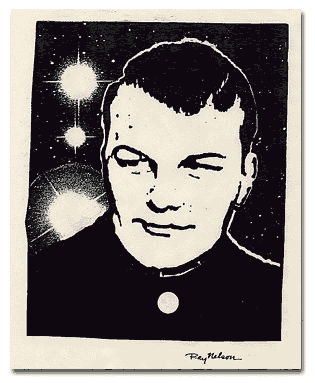
SF writer and Rotsler Award winning fan artist Ray Nelson died in his sleep overnight November 29/30 his son, Walter, announced today on Facebook. He was 91 years old.
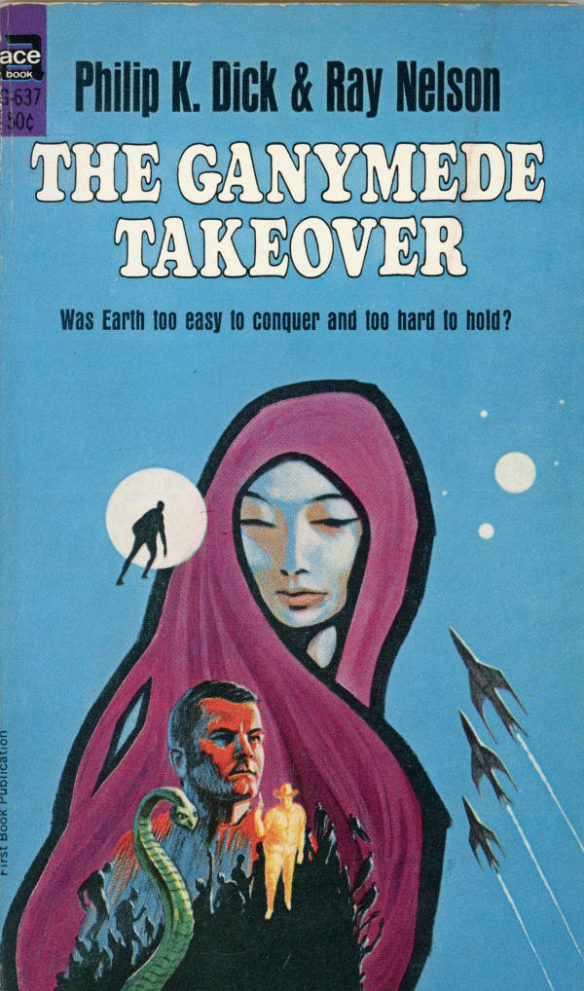
As an author Ray Nelson was best known for his short story “Eight O’Clock in the Morning,” which became the basis of John Carpenter’s film They Live. He also had a short story, “Time Travel for Pedestrians,” in Harlan Ellison’s Again Dangerous Visions (1972). Nelson collaborated with Philip K. Dick on The Ganymede Takeover. His 1975 book Blake’s Progress, in which the poet William Blake and his wife are travelers in space and time, has been called his best work by critic John Clute.
As an artist, in the 1940s Nelson appropriated the propeller beanie as a symbol of science fiction fandom. His fannish cartoons were recognized with the Rotsler Award in 2003. He was inducted to the First Fandom Hall of Fame in 2019.
The Ray Nelson website, which Walter set up, has more bibliographical information, and samples of his artwork. There you can also read a humorous article about Ray’s collaborator, “The Last Days of Philip K. Dick”.
Nelson was born in Schenectady, NY in 1931. He became an active science fiction fan while attending high school in Michigan. After graduation, he went to the University of Chicago (studying theology). In the Fifties he lived for four years in Paris, and met Allen Ginsberg, Gregory Corso and William Burroughs among others of the Beat Generation, as well as existentialists Jean Paul Sartre, Boris Vian and Simone de Beauvoir. He subsequently co-edited Miscellaneous Man, the first “Beatnik” little literary review. In Paris, he worked with Michael Moorcock smuggling Henry Miller books out of France.
Honors Nelson received as a writer included a special citation from the Philip K. Dick Award in 1983 for The Prometheus Man. As a fan, in addition to the awards already mentioned, he was a Best Fan Artist Retro Hugo finalist in 2001 (commemorating work done in 1950) and received the 2014 FAAn Lifetime Achievement Award.
Reprinted from File 770 Copyright by Mike Glyer 2022
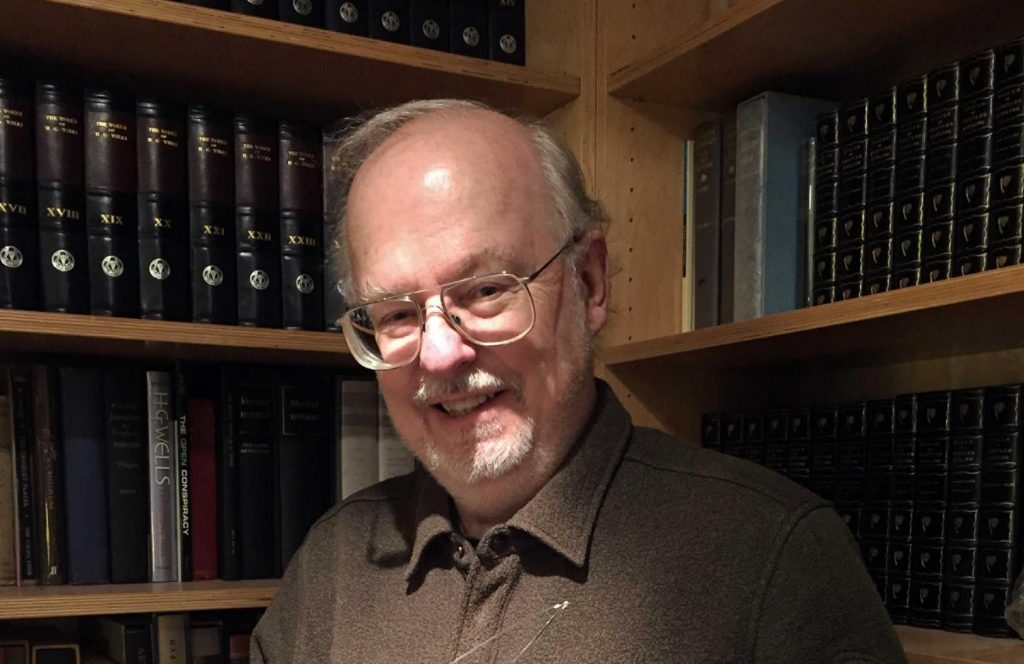
Five-time Nebula winner Greg Bear died November 19, a week after heart surgery from which he never awoke. A CT scan showed stroke damage was caused to many parts of the brain by clots that had been hiding in a false lumen of the anterior artery to the brain ever since an earlier surgery eight years ago. After a review of the possible outcomes by the medical team, and following the wishes expressed in his advance directive, Bear was taken off life support and died two hours later.
The author of over 50 books, Bear’s novels won Nebulas for Moving Mars (1995) and Darwin’s Radio. Three other works of short fiction won Nebulas, and two of those – “Blood Music” (1984) and “Tangents” (1987) — also won the Hugo.
Bear’s writing was very successful in translation, too. He twice won Japan’s Seiun Award, as well as the Ignotus Award (Spain), and Prix Apollo (France). Altogether his works have been translated into 19 languages.
Bear sold his first short story, “Destroyers”, to Famous Science Fiction at age 15, and along with high-school friends helped found San Diego Comic-Con.
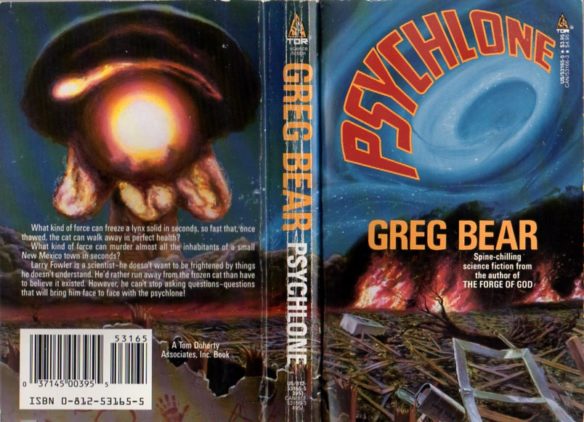
He also published work as an artist at the beginning of his career, including illustrations for an early version of the Star Trek Concordance, and covers for Galaxy and F&SF. He was a founding member of the Association of Science Fiction Artists. He even created the cover for his novel, Psychlone, a 1988 reprint from Tor.
In 1983 he married Astrid Anderson. They have two children, Chloe born in 1986, and Alexandra, born in 1990.
He was a guest of honor at the 2001 Worldcon, Millennium Philcon.
He served as President of SFWA from 1988 to 1990.
A resident of the Pacific Northwest, he was eligible for and won the first Endeavour Award in 1999 for Dinosaur Summer – and won it again the following year for Darwin’s Radio.
Bear participated in Sigma, a kind of think tank where science fiction writers share insights about the future with agencies laying real-world plans, twice making national news as one of the group’s representatives to Department of Homeland Security conferences.
Bear’s career honors include San Diego Comic-Con’s Inkpot Award (1984), the Robert A. Heinlein Award (2006) presented by the Heinlein Society, and the Los Angeles Science Fantasy Society’s Forry Award (2017).
Reposted from File 770 Copyright 2022.
Marvel's Fantastic Four


